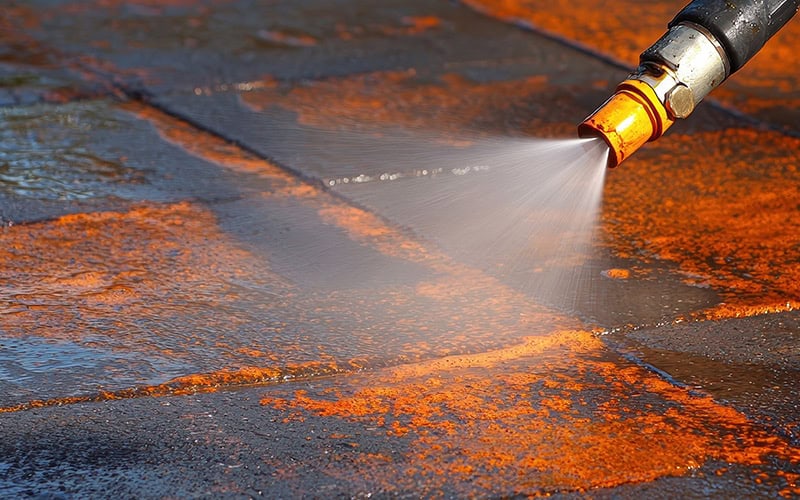
You walk outside one morning and notice bright orange stains running across your driveway. Maybe they're concentrated around a sprinkler head, near the edge of your lawn, or scattered across your pavers. At first, they look like dirt or clay, but no matter how much you rinse the area, they refuse to disappear.
If you live in Port St. Lucie, Stuart, Jensen Beach, Palm City, Jupiter, Vero Beach, or elsewhere on the Treasure Coast, you've probably seen these stains before. They're one of the most common questions homeowners ask because they seem to appear out of nowhere and become more noticeable over time.
The good news is that these orange stains usually aren't permanent. The challenge is identifying what's causing them before they continue spreading across your driveway, sidewalk, or patio.
Let's look at what these stains are, why they're so common on the Treasure Coast, and the safest way to remove them.
What Causes Orange Rust Stains?
In most cases, orange stains are exactly what they appear to be.
Rust.
Unlike rust on a vehicle or metal fence, these stains don't usually come from the concrete itself. Instead, iron particles react with oxygen and moisture, leaving behind the familiar orange discoloration.
The most common sources include:
- Irrigation systems
- Well water
- Fertilizers
- Metal patio furniture
- Landscape décor
- Air conditioner components
- Rusting hardware
Because the stains develop gradually, many homeowners don't notice them until they become widespread.
Why Do Sprinkler Systems Cause Rust Stains?
This is by far the most common cause we see throughout the Treasure Coast.
Many irrigation systems draw water containing naturally occurring iron.
Every time the sprinklers run, tiny amounts of iron-rich water land on your driveway.
As the water evaporates, those minerals remain behind.
Over weeks and months, the stains become darker and more noticeable.
If you've ever noticed orange staining forming in a perfect arc around a sprinkler head, your irrigation system is almost certainly responsible.
Why Is It So Common on the Treasure Coast?
Several local conditions make rust staining more common here than in many other parts of the country.
Irrigation Runs Year Round
Unlike northern climates, homeowners here use irrigation systems throughout most of the year.
That means concrete is constantly exposed to mineral deposits.
Hard Water
Many neighborhoods throughout the Treasure Coast have irrigation water containing elevated iron levels.
Even when the water looks perfectly clear, dissolved minerals remain.
Frequent Moisture
Morning irrigation combined with afternoon thunderstorms allows oxidation to continue almost daily.
The longer these minerals remain on the surface, the darker the stains become.
Are Rust Stains Damaging My Driveway?
Fortunately, rust stains are usually cosmetic.
They rarely indicate structural damage to concrete or pavers.
However, allowing them to remain for long periods makes removal increasingly difficult.
Over time:
- Stains penetrate deeper.
- Larger areas become affected.
- Cleaning becomes more time consuming.
- Curb appeal suffers.
Removing rust early almost always produces better results than waiting several years.
Can Pressure Washing Remove Rust Stains?
This is one of the biggest misconceptions homeowners have.
Standard pressure washing alone often won't remove rust stains.
That's because rust isn't sitting loosely on the surface like dirt or algae.
Orange rust stains and green algae often appear together on Treasure Coast driveways. Our guide Why Does My Driveway Keep Turning Green? explains why algae develops so quickly and how to keep it under control.
Instead, iron particles chemically bond with the concrete.
While pressure washing helps remove surrounding dirt and organic growth, specialized rust removal products are often needed to dissolve the staining safely.
Many Treasure Coast driveways have more than one type of staining. If you're also noticing dark organic discoloration, read Why Is My Concrete Turning Black? to learn what causes those stains and how they're removed.
Using the wrong chemicals can permanently discolor decorative concrete, damage nearby landscaping, or leave uneven cleaning marks.
Should I Use Store-Bought Rust Removers?
Many homeowners head to the hardware store hoping a bottle of rust remover will solve the problem.
Sometimes it works.
Sometimes it creates a much bigger problem.
Certain acidic cleaners can:
- Etch concrete
- Lighten colored pavers
- Damage surrounding grass
- Harm nearby plants
- Create uneven discoloration
Before applying any chemical cleaner, always verify it's designed specifically for your type of surface.
Testing a small, inconspicuous area first is also a smart precaution.
Can Rust Stains Be Prevented?
Often, yes.
The first step is identifying where they're coming from.
For many Treasure Coast homes, adjusting sprinkler heads so they no longer spray directly onto the driveway can dramatically reduce future staining.
Other preventative measures include:
- Removing rusting metal furniture.
- Repairing irrigation leaks.
- Cleaning mineral deposits before they become severe.
- Regular exterior maintenance.
Addressing the source is just as important as removing the existing stains.
Can Rust Stains Come Back?
Unfortunately, yes.
Removing the visible rust stain doesn't eliminate the source of the problem. If your irrigation system continues spraying iron-rich water across the driveway every morning, new stains will gradually develop again.
Think of rust stains like hard water spots on a shower door. Cleaning restores the appearance, but unless the source is addressed, the stains eventually return.
That's why professional rust removal focuses on two goals:
- Removing the existing stains.
- Helping homeowners identify what's causing them.
Correcting the source often makes the biggest difference in preventing future staining.
Rust Stains on Concrete vs. Pavers
Although both surfaces can develop rust stains, they don't always respond the same way.
Concrete
Concrete is porous, allowing iron deposits to penetrate below the surface.
Older concrete that has never been professionally cleaned may require additional treatment because the staining has had years to soak into the material.
Fortunately, most rust stains can be significantly reduced with the proper cleaning products and techniques.
Pavers
Pavers often have textured surfaces that trap minerals more easily than smooth concrete.
If the pavers have been sealed, the protective sealer may help slow staining by reducing how much iron penetrates the surface.
However, aggressive rust removers can sometimes affect the sealer itself.
Using the wrong product may strip portions of the protective coating, leaving the surface uneven or requiring resealing afterward.
If your pavers have already been sealed, our Complete Guide to Paver Sealing in Florida explains how sealing helps protect your investment and why routine maintenance is still important.
When Should You Call the Professionals?
Some rust stains respond well to homeowner cleaning.
Others don't.
Professional cleaning is often the better option when:
- The stains have been there for several years.
- Large portions of the driveway are affected.
- Previous cleaning attempts haven't worked.
- Decorative concrete or pavers need special care.
- You don't know what's causing the stains.
- You want to avoid damaging surrounding landscaping.
Professional exterior cleaning companies have access to commercial-grade rust removal products that aren't typically available to homeowners. More importantly, they know when to use them and how to protect the surrounding surfaces during the cleaning process.
If your driveway continues developing orange stains despite repeated cleaning, it may be time to consider professional pressure washing in Port St. Lucie. Identifying the source of the staining is often just as important as removing it.
Final Thoughts
Orange rust stains can make even a well-maintained home look neglected, but they're usually much easier to address than most homeowners realize.
Whether the stains are caused by irrigation water, metal furniture, or another source of iron, the key is acting before they become deeply embedded in the surface.
If you've noticed orange discoloration spreading across your driveway, sidewalk, or pavers, don't assume it's permanent. With the proper cleaning methods and a little detective work to identify the source, most rust stains can be greatly reduced while helping prevent them from returning.
Need a quote for Pressure Washing?
A Buff & Beyond provides professional pressure washing services designed to clean and protect your property and deliver an outstanding look!
Frequently Asked Questions
This is one of the strongest indicators that your irrigation system is the source of the problem.
Many sprinkler systems use water containing naturally occurring iron. Every time the sprinklers run, tiny amounts of those minerals land on the concrete. As the water evaporates, the iron remains behind and begins oxidizing, creating the familiar orange stains.
If the staining follows the spray pattern of your irrigation system, adjusting the sprinkler heads may significantly reduce future buildup.
Usually not.
Pressure washing is excellent for removing dirt, algae, mildew, and other surface contaminants, but rust stains are different. Iron chemically bonds with the concrete, meaning specialized rust removal products are often needed to dissolve the staining before pressure washing can fully restore the surface.
Using pressure alone may improve the appearance slightly, but it rarely removes heavy rust staining completely.
Not necessarily.
Fresh stains are often much easier to remove than stains that have been left untreated for several years.
The longer iron remains on the surface, the deeper it penetrates into the concrete or pavers. Early treatment usually produces the best results and may prevent the need for more aggressive restoration methods later.
No.
Bleach is designed to treat organic growth like algae and mildew. Rust stains are caused by iron oxidation, not living organisms.
In many cases, bleach has little to no effect on rust stains and may even make homeowners think the staining is permanent when a specialized rust remover would have been much more effective.
The staining itself is primarily cosmetic, but using the wrong cleaning products can create additional problems.
Strong acidic cleaners may damage certain types of pavers or affect existing sealer. That's why it's important to identify the surface material before attempting rust removal.
Professional evaluation is often worthwhile for decorative pavers or high-end outdoor living spaces.
The best long-term solution is to eliminate the source of the iron.
This may involve adjusting sprinkler heads, repairing irrigation leaks, replacing rusting landscape fixtures, or scheduling periodic professional cleanings before heavy staining develops.
Addressing the cause instead of simply cleaning the symptoms usually provides the longest-lasting results.